


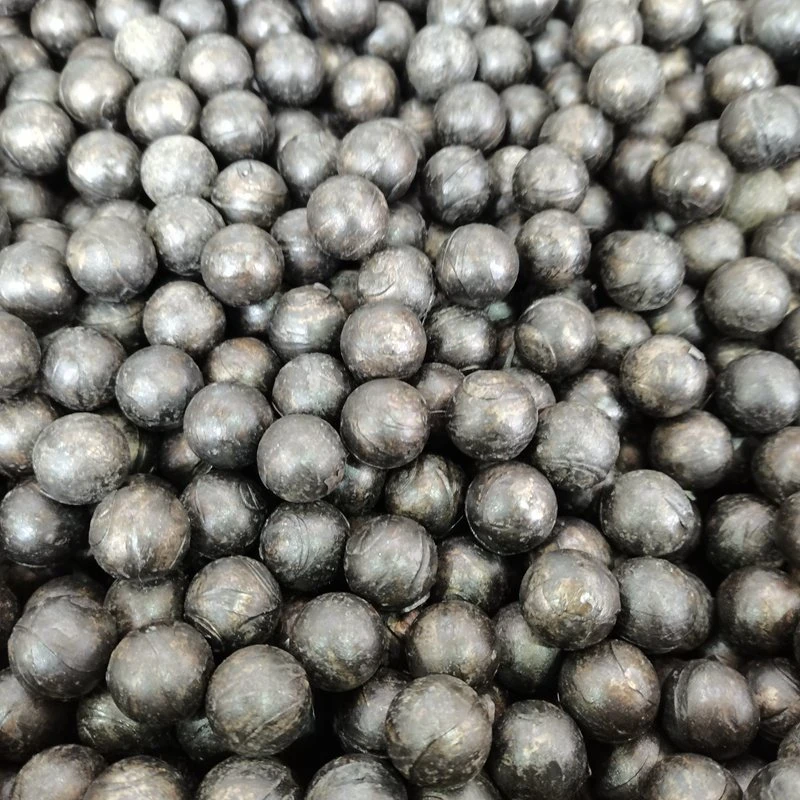
Steel Balls For Ball Mill
High Hardness & Wear Resistance: Surface hardness ranges from 57 to 67 HRC, with a core-to-surface hardness variation under 5 HRC.
Low Breakage Rate: A breakage rate below 1% minimizes ball consumption, replacement downtime, and operational interruptions.
Tailored Material Selection: Offered in premium alloys like 65Mn, B2, B3, and GCr15 to suit diverse grinding requirements and mill conditions.
Product Introduction
Steel balls for ball mill grind raw materials-including ore, cement clinker, and coal-through continuous impact and friction inside the drum. Manufactured via hot rolling or precision forging, they undergo advanced quenching and tempering to achieve an optimal balance of hardness and toughness. This controlled hardness gradient ensures durable wear resistance, while the low breakage rate significantly cuts operating costs. Available in various diameters and material grades for both wet and dry milling, steel balls for ball mill are widely deployed across mining, cement, thermal power, and chemical processing industries.
Product Specifications
|
Parameter |
Value / Range |
|
Applicable steel ball size |
φ20–φ125 mm |
|
Surface hardness |
57–67 HRC |
|
Core hardness |
55–62 HRC |
|
Hardness difference (surface vs. core) |
<5 HRC |
|
Breakage rate |
<1% |
|
Impact toughness |
12–35 J/cm² (depending on material) |
|
Applicable materials |
Medium carbon steel, low alloy steel, 65Mn, B2, B3, GCr15 |
|
Production process |
Hot skew rolling / forging |
|
Heat treatment |
Quenching + tempering |
|
Certification |
ISO 9001:2015, ISO 45001:2018, ISO 14001:2015 |
Available material grades:
65Mn – General-purpose grinding ball for mining and cement applications. Good wear resistance and cost-effectiveness.
B2 – Medium-carbon alloy steel with improved hardenability. Suitable for wet grinding in metal mines.
B3 – Higher alloy content for demanding abrasion conditions. Extended service life in hard ore grinding.
GCr15 – Bearing-grade steel with high hardness and uniformity. Used where precise hardness distribution is required.
Key Features & Benefits
Consistent hardness from surface to core
Our quench and temper process is controlled to keep the hardness differential below 5 HRC. This means the ball wears evenly throughout its life, rather than developing a soft core that leads to premature failure.
01
Low breakage rate
Dense internal structure from the skew rolling process, combined with controlled heat treatment, keeps the breakage rate under 1%. Fewer broken balls means less downtime for screen cleaning and lower replacement costs.
02
Wear rate tested against cast and forged alternatives
In comparative trials, our rolled balls have shown up to 30% lower wear rate than cast balls and 10–15% higher toughness than conventional forged balls. This translates directly into longer grinding cycles and reduced media consumption per ton of ore milled.
03
Full size range from one supplier
With φ20–φ125 mm coverage, we can supply the complete ball charge for a grinding circuit - from large balls for coarse grinding to smaller balls for fine and regrind stages.
04
Self-manufactured rolling equipment
Because we build our own skew rolling mills, we control the forming process from start to finish. This allows us to adjust roll pass design and process parameters quickly when customer requirements change.
05
Manufacturing Process
Our steel balls are produced through a continuous hot skew rolling process:
Billet cutting
Round steel bars are cut to length with square, consistent ends.
Induction heating
Billets are heated uniformly to 850–1100°C, depending on material grade. Bearing steel (GCr15) is heated at the lower end of this range.
Skew rolling
Heated billets pass between two cross-arranged rolls rotating in the same direction. The spiral roll pass gradually shapes the billet into a ball, with the connecting neck between adjacent balls thinning and breaking naturally.
Quenching
Balls drop directly into the quench system for rapid cooling, producing a hard martensitic surface layer.
Tempering
Balls are tempered to relieve quenching stress and adjust core toughness, balancing wear resistance with impact strength.
Inspection
Each batch undergoes hardness testing and drop testing (free fall from 2 m onto steel plate, five times, no cracks permitted), plus dimensional and visual checks.
Applications
Our steel balls for ball mill are used as grinding media in:
Mining and mineral processing – Iron, copper, gold, silver, lead-zinc, and other metal ore grinding, both wet and dry circuits.
Cement and building materials – Raw meal, clinker, and slag grinding in tube mills.
Thermal power generation – Coal pulverization in ball and tube mills, and limestone grinding for flue gas desulfurization.
Chemical processing – Grinding of chemical raw materials, pigments, and fillers.
Industrial minerals – Silica sand, calcium carbonate, fly ash, and coal-water slurry preparation.
Customization
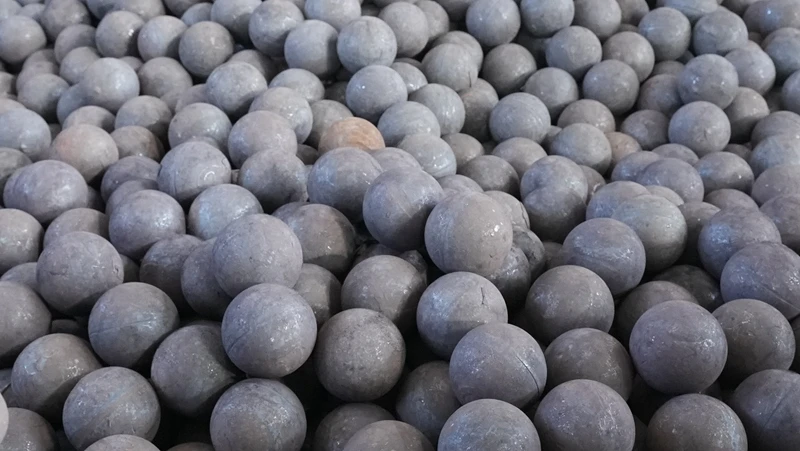
Material grade selection – Choose 65Mn, B2, B3, GCr15, or specify your required chemical composition.
Hardness profile adjustment – Quench and temper parameters can be tuned to match your ore abrasiveness and impact conditions.
Size and packaging – Balls can be supplied in ton bags, steel drums, or drum-on-pallet configurations. Custom packaging available.
Trial orders – Sample batches can be supplied for on-site testing before committing to volume orders.
Technical support – Our engineers can review your mill operating data and recommend ball size, material, and charging strategy.
FAQ
Q: What is the difference between hot-rolled and forged grinding balls?
A: Hot-rolled balls are produced by rolling heated steel bars into shape, while forged balls are made by hammering or pressing steel billets. The manufacturing method affects production cost, available sizes and delivery time. In actual use, grinding performance depends more on the steel grade, heat treatment and working conditions than on the process name alone. We supply both types for different mill requirements.
Q: Can you make grinding balls to the specifications we already use?
A: Yes. Send us your current specifications or a sample, including ball diameter, steel grade, hardness and breakage rate. We will check the requirements against our production range and confirm what we can supply. If you are considering a change of supplier, a trial batch is a practical way to compare performance before committing to a full order.
Q: What quality checks are carried out before shipment?
A: We check the steel and forming process, along with the quenching and tempering conditions that affect the finished ball's hardness and toughness. Hardness and impact or drop tests are carried out according to the product requirements. Results are recorded by batch, so any quality issue can be traced back to the relevant production lot.
Hot Tags: steel balls for ball mill, China steel balls for ball mill manufacturers, suppliers, factory, cast steel grinding media surface hardness 58 63, ceramic grinding media 25mm diameter, chrome steel balls core hardness 55 59, Grinding Cylpeb, low chrome cast iron balls hrc 62 hardness, low chrome cast iron balls surface hardness 58 63
You Might Also Like



Send Inquiry
