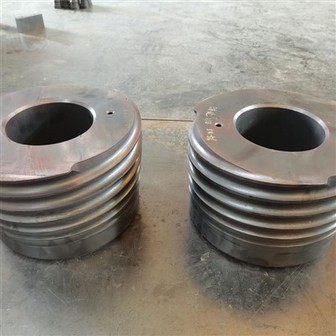

Main structure of steel ball skew rolling mill
A skew rolling mill is a type of skew rolling mill used to produce steel balls. The steel ball rolling process originated in the former Soviet Union and is also known as skew rolling. Skew rolling equipment mainly consists of two intersecting, non-parallel straight rolls that rotate in the same direction around their respective axes. The principle is to utilize the contact friction between the rolls and the workpiece to drive the workpiece forward. This rolling process is also called spiral rolling. Rolled materials include medium carbon steel, low alloy steel, and medium alloy steel. Its advantages include good stability in continuous rolling production, high workpiece quality, high yield, and high production efficiency.
The main structure of the ball mill is basically the same as that of the spiral rolling mill. The mill consists of a base, columns, an upper crossbeam, a pressure measuring device, a roll axial and phase angle adjustment mechanism, upper and lower guide plates and their adjustment mechanisms, and a feed angle adjustment drum. The four columns, upper crossbeam, and base are connected together by four tie rods on each side, forming the mill frame. The columns and base are made of cast steel, while the crossbeam is a welded structure.
The roll assembly is mounted on a rotating drum. When adjusting the roll feed angle, the rollers rotate between the crossbeam and the base, adjusting the rolls to the desired angle. Roll clamping devices are located on both sides of the frame and are used to adjust the roll gap. These devices are driven by a motor via a worm gear reducer, which drives two clamping screws to radially adjust the roll gap. A clutch between the two reduction mechanisms allows the clamping screws to operate simultaneously or individually, ensuring unequal roll gaps to meet rolling process requirements.
To ensure rolling accuracy, the rolls are also equipped with an axial adjustment mechanism. Upper and lower guide plates are installed between the two rolls. The upper guide plate is fixed to the support of the upper crossbeam and can be manually adjusted via the screw clamping mechanism. Alternatively, the upper guide plate can be leveled using four screws. The lower guide plate is fixed to the base via dovetail grooves and clamping bolts, and its height can be adjusted using shims.
The main drive system includes a main motor, a combined gearbox, universal joints, and a balancing device. Each roll is driven by two universal joints. The length and center distance of the universal joints are determined by the maximum length of the billet. The minimum length of the billet depends on the maximum feed angle of the rolls. Gears connect the roll ends to universal joints, allowing adjustment of the roll phase angle, crucial for spiral rolling. A receiving platform (millimeter front end) is mounted between the universal joints.
Pneumatic pushers insert heated steel billets through guide sleeves into the roll gap for rolling. After rolling, the steel balls immediately fall into a water tank at the rear of the mill for quenching, then are conveyed to another hopper by a scraper conveyor.
The simplified ball mill has a fixed and non-adjustable feed angle. The billet is fed from one side of the mill, simplifying the frame structure and reducing equipment weight. This side-feeding method allows for more flexible universal joint selection, improves strength, and extends service life. This equipment is suitable for rolling small-diameter steel balls.