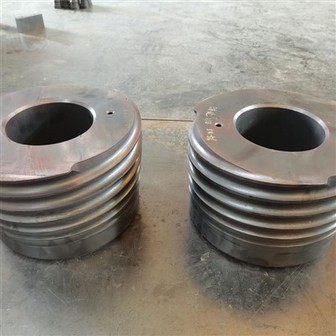

Roll Welding Steps
Pre-welding Preparation: A Solid Foundation is Crucial
Just like building a house requires a foundation, the pre-welding preparation of the rolls directly affects the welding quality:
Surface Treatment: Grind the welding area with a grinding wheel to remove oxide layers and oil stains, revealing the metallic luster.
Preheating Treatment: Heat the rolls to a suitable temperature to prevent cracks during welding.
Beveling: Process the appropriate bevel shape according to the roll material and thickness.
Welding Operation: Remember the Key Techniques
This is the core of the entire welding process and requires special attention:
Welding Material Selection: Match the welding rod or wire to the roll material.
Welding Sequence: Use segmented symmetrical welding to avoid localized overheating and deformation.
Parameter Control: Current, voltage, and speed must be coordinated.
Interlayer Cleaning: Clean the weld slag after each layer is welded.
Post-welding Treatment: Details Determine Success or Failure
The post-welding treatment is equally important:
Slow Cooling Treatment: Wrap the rolls in insulating material to allow them to cool slowly.
Stress relief: Residual welding stress is eliminated through heat treatment.
Quality inspection: The internal quality of the weld is inspected using a flaw detector.
Finishing: The welded area is turned or ground to restore dimensional accuracy.